
TEAM STORIES
E.T.
Department:Noise Certification Engineer / Noise & Vibration / Aeronautics Development Department
Year Joined:2025
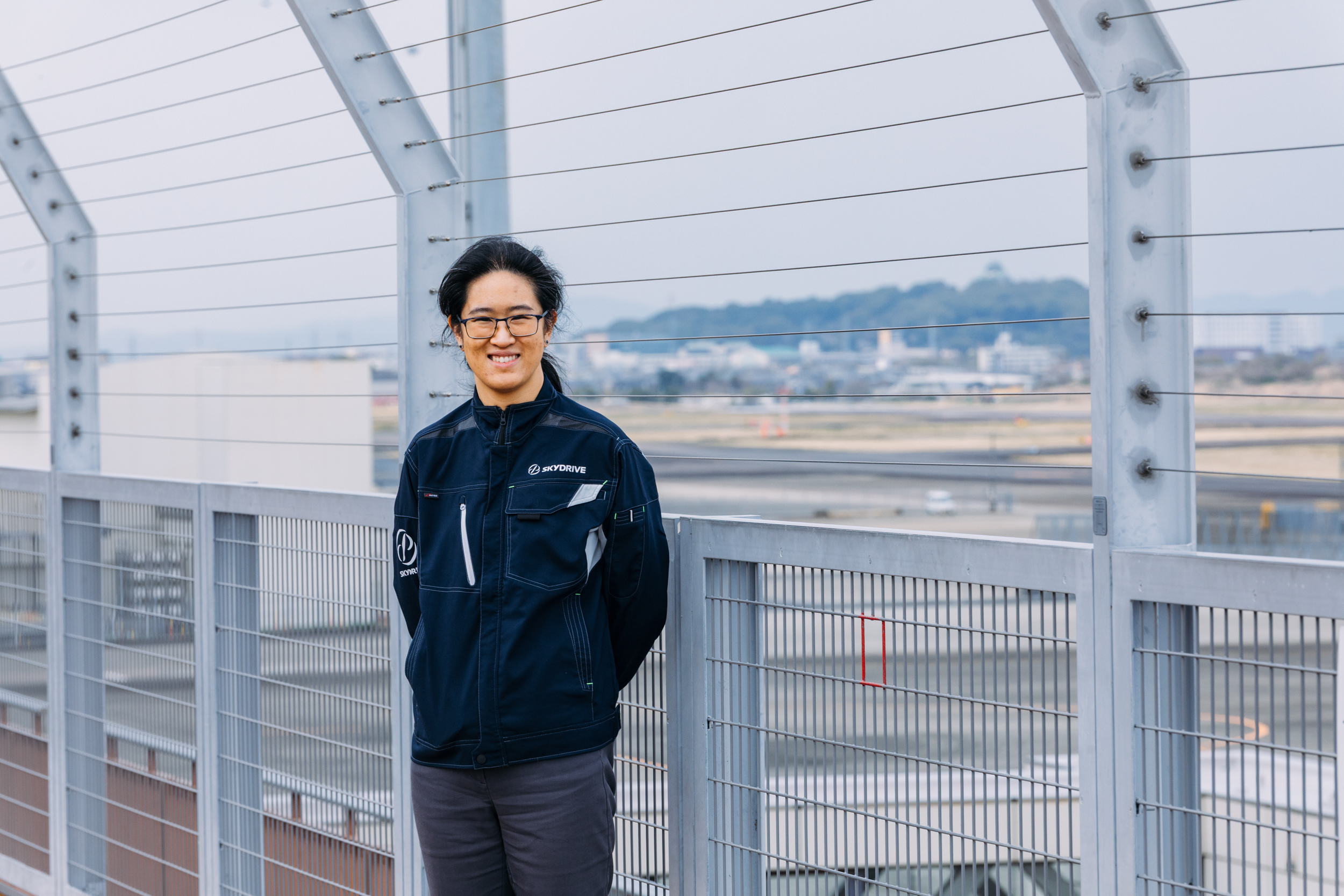
E.T. Interview
Profile
E.T. is a Noise Certification Engineer in the Noise & Vibration team of SkyDrive’s Aeronautics Development Department, with nine years of experience in acoustics, vibration, and aerospace data acquisition. Her career began with a fascination for sound itself — from concert hall acoustics in her undergraduate research to aircraft noise certification at the frontier of Urban Air Mobility.
Before joining SkyDrive, E.T. developed her expertise across two leading aerospace companies. At Pratt & Whitney Canada, she built a reputation as a hardware and data acquisition specialist, developing the architecture for a predictive propeller balancing service and a smartphone diagnostic tool for customer noise issues. She then moved to De Havilland Canada, where she deepened her focus on aircraft noise certification while continuing to support vibration and interior noise activities, and built strong ties with the Flight Test Instrumentation team.
E.T. joined SkyDrive in October 2025, drawn by the once-in-a-century opportunity to shape how a new class of aircraft integrates into the communities it serves.
Why did you decide to join SkyDrive?
What SkyDrive is working on really is a once-in-a-century development in technology — both exciting and challenging. It presents a particularly interesting opportunity for noise engineering, since these aircraft will operate in densely populated areas, meaning the noise can potentially affect far more people than conventional aviation does today.
I have always been drawn to problems that push me to grow, and this looked like the perfect environment to pursue a genuinely interesting technical challenge while keeping a strong focus on how my work affects real people. Noise impact and passenger experience are going to be critical in building community and customer trust in AAM — and I am simply excited to be part of figuring out how to do that well.
How would you describe your job in one sentence?
My job is to ensure the comfort and hearing health of the passengers, pilot, and surrounding community.
How do you evaluate the strengths of the multicopter design and the advantages of the SD-05?
From a noise perspective, multicopters are generally easier to make quieter during takeoff and landing than a winged configuration. In hover, winged aircraft can suffer from interactions between the rotor wake and the wing surface, which increases overall noise levels. By eliminating that interaction, the multicopter design is inherently better suited to short-range inner-city operations — precisely the use case where noise matters most.
What kind of social value can the SD-05 create?
The acoustic advantages of the multicopter make it genuinely better suited to solving intra-city mobility challenges than a winged configuration. A vehicle optimized for quiet takeoff and landing can serve well-travelled, well-defined routes within a city — providing real congestion relief while minimizing noise impact in the densely populated areas it flies over and lands in. That combination of utility and community sensitivity is what makes this technology worth pursuing.
Are there any principles or mottos that guide you in your work?
I have two guiding principles: everything we do affects other people, and it is of the utmost importance that we land on the truth.
In Canada, where I grew up and was educated, all engineers receive an iron ring upon graduating — worn on the working hand as a reminder of a bridge that collapsed, not once but twice, due to engineering negligence. It is a symbol of our duty to society. Even now, living in Japan, I still wear that ring every day.
But even the best engineers make mistakes. Catching those mistakes requires complete honesty — with ourselves and with each other. Each of us only ever holds a few pieces of the full picture. Technical expertise matters, but what I learn from others is equally critical. In aviation, the cost of implementing the wrong solution is simply too high.