TEAM STORIES
E.A.
Department:FCL Team Leader, System Dept.
Year Joined:2024
E.A. Interview
Profile
E.A. of SkyDrive's Flight Control Law (FCL) Team is the driving force behind developing an intelligent and reliable "brain" for our next-generation eVTOL. Previously, he designed advanced flight control laws and navigation algorithms for unmanned air vehicles (UAVs), bringing deep expertise in system modeling, simulation, and multidisciplinary integration. Today, E.A. leverages this strong background to lead control law design and system integration, ensuring the SD-05 delivers predictable and safe responses across all flight conditions.
“The ‘brain’ of SD-05 — designing deterministic flight control for absolute safety”
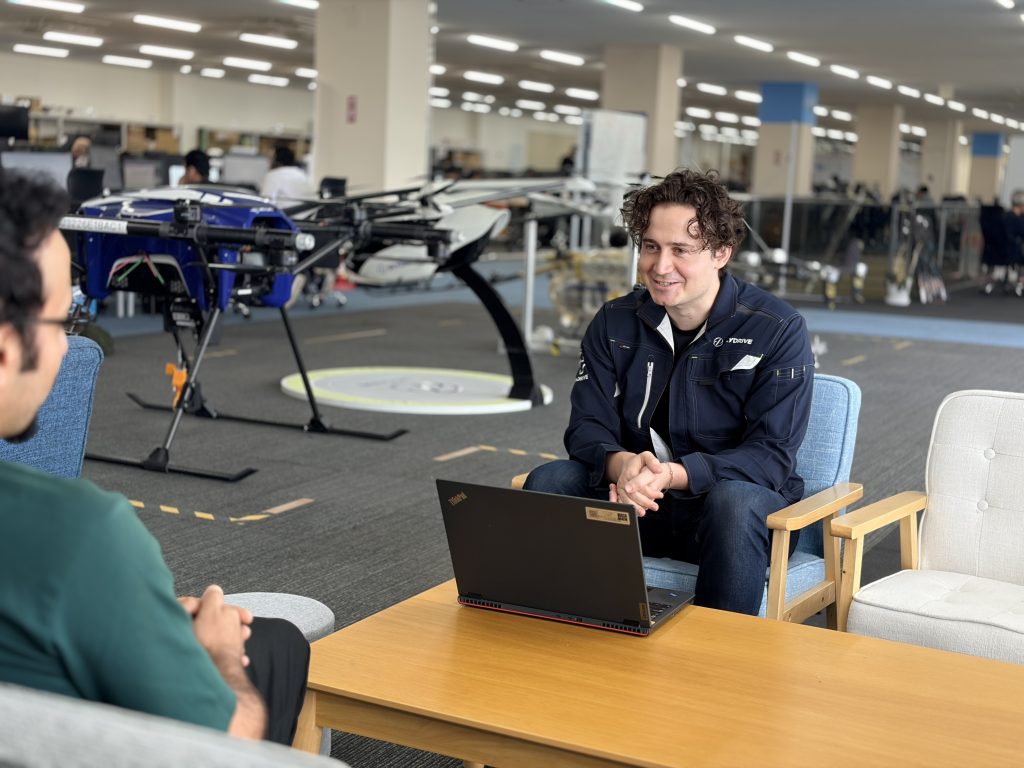
Q. How would you describe your job?
My core responsibility is the design and development of the flight control laws—the algorithms that act as the ‘brain’ of the SD-05. This system processes sensor data, translates pilot input into control surface movements, and is essential for maintaining aircraft stability and responsiveness. Beyond basic flight, the goal is smooth and predictable performance across all operational scenarios, including critical edge cases like severe weather or sensor malfunctions. Achieving this requires close collaboration with other teams to ensure seamless system integration.
Q. Could you explain how responsibilities are divided between Thales and SkyDrive in developing the flight control system?
The division of responsibilities mirrors a standard aerospace partnership. The Thales team is responsible for the flight control computer hardware and the software certification processes, leveraging their extensive experience with aviation standards such as DO-178C. In parallel, the SkyDrive team takes ownership of the control law design and overall system integration. Our role involves developing the necessary algorithms and ensuring the safe, cohesive operation of all components.
Close collaboration between the two teams is essential: hardware limitations of Thales’ platform directly shape the development of our control code, and their certification knowledge helps our validation and verification methodologies.
Q. How do you define the “intelligence” of the flight controller, and what does it take to achieve type certification?
Our aircraft’s intelligence is founded on sensor fusion, which processes data from multiple sources like Inertial Measurement Units (IMUs), air data systems, and GPS. This cross-checking ensures high precision and reliable state awareness, even in the event of a single sensor failure.
Crucially, the control laws governing our flight are based on deterministic algorithms with fixed parameters, not real-time learning AI. This intentional design choice guarantees flight safety by ensuring the same, proven logic is executed consistently on every flight.
Achieving Type Certification from regulatory bodies such as JCAB, FAA, or EASA involves a rigorous, formal process. Success is not merely a matter of good performance; it requires comprehensive documentation, extensive testing, and definitive proof that all potential failure modes are either safely mitigated or entirely prevented.