
TEAM STORIES
L.M.
Department:Director of Structure Development
Year Joined:2024
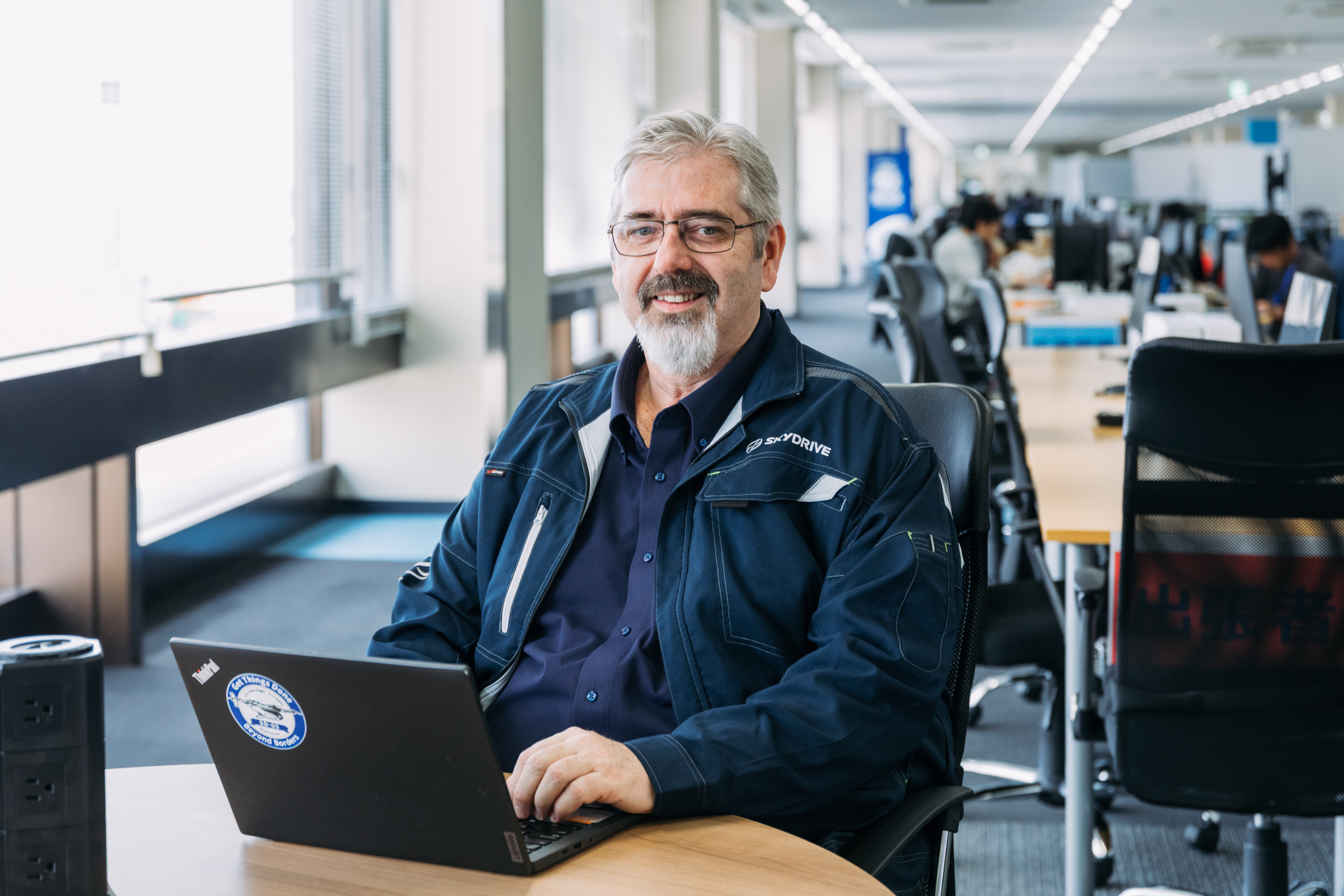
L.M. Interview
Profile
L.M is an Aeronautical Engineer and senior aerospace leader with over 28 years of experience across commercial aviation, defense, and Urban Air Mobility. His career combines deep structural engineering expertise with hands-on leadership — from designing flight-critical structures to directing global certification programs.
He spent more than two decades at Embraer, contributing to iconic programs including the ERJ 145, E-Jets E1 and E2 families, Phenom business jets, and the KC390 military transport. As Product Design Leader and Zonal Aircraft Integrator, he led the design of primary structures including wings, empennages, and pylons, while also establishing himself as a recognized GD&T Expert and Instructor. He later joined EVE Air Mobility as a Senior Structures and Systems Engineering Specialist, managing eVTOL structural integration and leading the Chief Engineer Mentoring Program. Today, based in Nagoya, Japan, He serves as Director of Structure Development at SkyDrive — overseeing certification strategy, structural testing, materials and processes, and manufacturing integration for the SD-05 eVTOL program.
Why did you decide to join SkyDrive?
My decision was driven by SkyDrive’s position as a global leader in forward-thinking aerospace. The role offered exactly the kind of career progression I was looking for: leading structural development for a groundbreaking eVTOL program, within the context of Japan’s world-renowned engineering culture. SkyDrive has a unique blend of bold innovation, technical excellence, and international collaboration — and I was deeply inspired to become part of the team pioneering this new era of flight.
How would you describe your job in one sentence?
For this answer, I will use the mission of the Structure Department:
“Challenging engineering limits to deliver safe, lightweight, and sustainable structural solutions that define the new standard for global aerial mobility.”
As Director, I oversee all primary and secondary structures, certification strategy, structural testing, materials and processes, and the integration of structures into manufacturing. I am accountable for structural performance, safety, compliance, and lightweight aircraft structures — as well as for aligning engineering, certification, and production teams. My main outputs are certifiable structural designs, validated test results, manufacturing-ready solutions, and a high-performing engineering organization equipped with modern, agile workflows.
How do you evaluate the strengths of the multicopter design and the advantages of the SD-05?
The core structural strength of the multicopter design lies in its mechanical simplicity and localized load paths. By eliminating complex wings and tilt-mechanisms, we significantly reduce weight and move toward a more certifiable, high-reliability platform.
For the SD-05 specifically, the primary advantage is its compact, high-stiffness rotor frame architecture. This directly addresses our greatest challenge — and our competitive edge: managing the high-torque and high-frequency vibrations of multiple electric motors mounted directly to the frame. We have optimized this structure to be incredibly rigid for stability, yet lightweight enough to maximize battery payload.
A concrete example is the rotor frame integration itself. In a wingless design, the frame must act as the “nervous system” of the aircraft — integrating motors and batteries into a singular cohesive unit. Using Design Workshops for functional consolidation, reducing part counts while increasing safety, is exactly how we are navigating the rigorous road to Type Certification.
What kind of social value can the SD-05 create?
The true social value lies in point-to-point freedom — a more democratic form of aviation, integrated into the city rather than separated from it.
Take urban friction. Traditional ground transportation in mega-cities like Tokyo or Nagoya is reaching its limit. The SD-05 transforms a “2D” traffic problem into a “3D” solution. It can operate closer to where people live and work, cutting the “dead time” spent in transit.
Then there is an emergency response. In Japan, geographical challenges and natural disasters are a reality. A multicopter’s ability to take off and land in confined, unprepared spaces is a game-changer. With its high-stiffness frame optimized for stability, the SD-05 could take off from a hospital rooftop and land directly on a small pad at a local clinic — in 15 minutes.
Are there any principles or mottos that guide you in your work?
My guiding principle is that nothing exists in isolation. I push my team to look past their specific silos and see how every structural choice affects the whole aircraft.
I also believe that complexity is the enemy of certification. My experience has taught me that the better solution is usually the simplest one — with safety always first. The clearer and more elegant the path, the more reliable the outcome.
Ultimately, our goal is to blend the disciplined heritage of global aviation with the bold agility of Urban Air Mobility. We are not just building a flying machine — we are engineering a new standard of trust in the sky.